
If you’re not familiar with the Shot Scope V5 and its key features, it might be worth watching my short Shot Scope V5 First Look video (below), where I look at what comes inside the box, discuss its key features and compare it with the Shot Scope V3 watch.
View video transcript
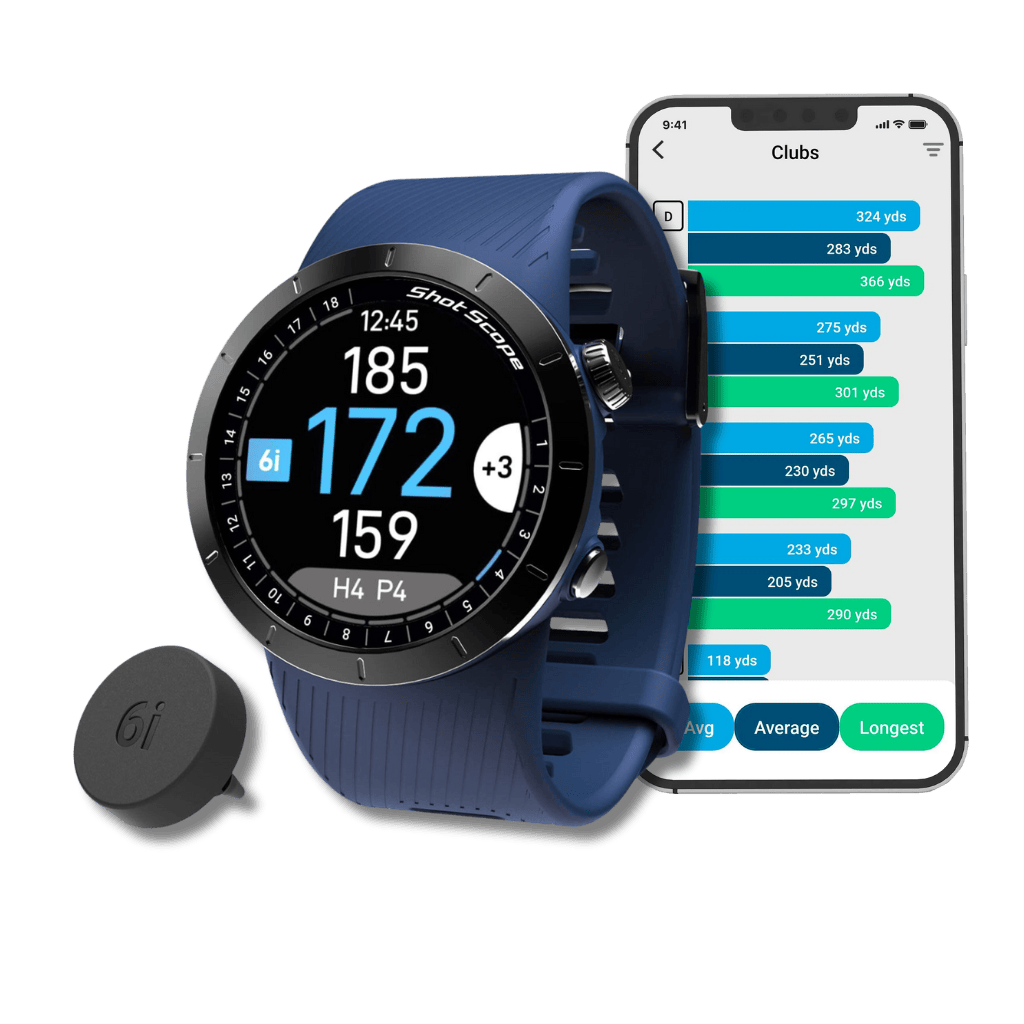
Shot Scope has today announced the release of this. This is the Shot Scope V5 GPS and performance tracking golf watch. Now this is the big brother to the incredibly popular V3 model, and I’ve been fortunate enough to get my hands on it prior to release. So in this video I’m going to introduce you to what comes inside the box, I’m going to show you the device out of the box and talk about its key features, and I’m also going to tell you what has changed between the V3 and the V5 just in case you are thinking about upgrading. If after watching this video you decide you want to buy a V5 or you just want to find out a little bit more, there’s a direct product link in the description below.What’s In The BoxInside the box you’ll find the Shot Scope V5, 16 second generation performance tracking tags, a quick start user guide, and a USB charging cable.Design and Physical FeaturesIn terms of looks and feel, the V5 is actually really quite similar to the X5. Both of these watches have the same strap and on first glance look very similar. The big difference between the two is that the V5 doesn’t have the Chrome bezel around the face. The other big difference you’ll notice is there are four buttons on the outside of the casing on the V5. This is because the $1.2\text{ inch}$ daylight readable color screen is controlled using these four buttons in a similar style to the G5 model.On-Course Performance Tracking and StatisticsOn the golf course, the V5 allows you to track your performance using the 16 tracking tags provided and the technology built into the watch. The great thing about this is you have access to over $1,100$ T-level statistics which are available via the Shot Scope mobile app or the online dashboard and these can be used to help you improve your game.GPS and Course Mapping FeaturesIn terms of GPS on the golf course, you’ll be able to view the distance to the front middle and back on the green on the hole you are playing as well as view Hazard information, layup information, and dog legs. Also included on the V5 are full hole overview maps and these allow you basically to see a bird’s eye view in color of the hole you are playing. The other useful feature built into this is you can use the buttons to pick specific points on that map to find out how far you have to hit to those points. In addition to this you can also see an overview of the green on the hole you’re playing and you can move the pin around to get a more accurate yardage.Other On-Course FunctionalityAs well as these useful GPS features you can find out how far you hit your last shot and it has a built-in digital scorecard. Finally during your round if you’re interested in finding out how far you are walking then you’ll be able to track your steps as well.Personalized Displays and Battery LifeOne other feature that is built into the V5 that you won’t find on any other Shot Scope devices at this moment in time are the personalized displays. These allow you to change the color of the data displayed on the screen and choose between either blue, pink, red, green or orange which I think is a really nice touch. According to Shot Scope the device will be able to manage two rounds from a full charge and like all other Shot Scope devices there is no ongoing monthly payment or subscription and all future firmware updates are free of charge as well. As this as an owner of a Shot Scope product you’ll be able to get access to Shot Scope’s My Strategy tool which allows you to form a strategy for any course within the Shot Scope database which is around about $36,000$ courses.General Watch UseFinally away from the golf course the V5 can also be used as a general day-to-day watch and that step counter works off the golf course as well.V5 Comparison to the V3 ModelSo now that we have covered the main features found on the Shot Scope V5 let’s do a quick comparison to the V3.Display and Screen UpgradeFirst of all obviously the display has been upgraded so we now have a lovely modern looking display on the V5 compared to the somewhat square and maybe retro display found on the V3. You’ll also see that the screen itself is a complete overhaul and it’s more vibrant and displays the data much clearer.Strap UpgradeThe strap has also had an overhaul so on the V5 you’ll find the new premium dust resistance strap which has two fixing Loops to keep it securely in place.New Features on the V5As mentioned earlier the V5 displays the map for the hole you are currently playing as well as its green, it has a built-in digital scorecard, it allows you to track your steps and you’ll also get that useful dog leg information which are some features that just simply aren’t found on the V3.ConclusionSo there you have it that’s our first look at the brand new Shot Scope V5 GPS and performance tracking golf watch. If you have any questions about any of the content covered in this video or any questions about the V5 or indeed any other Shot Scope products make sure you drop them in the comments below and I’ll try my best to answer them. As mentioned earlier if you’re interested in purchasing the V5 or just finding out more that direct link is in the description below and if you’ve got value from this video then be sure to hit that like button and subscribe for more future Shot Scope videos. Now if you’re interested in taking a closer look at some of the performance statistics available to Shot Scope users then why not check out this video here.
V5 and X5 prices
At the time of writing this article, the Shot Scope V5 is available for £199.99. The premium X5 model is slightly more expensive at £279.99. The good news is that you can save 15% on these products by entering my code ‘ANDYSGOLF‘ at checkout.
So, there’s only around £40 difference between the two watches, but how do they compare in terms of looks and construction?
Looks and construction
At first glance, both watches look very similar. They have the same casing, meaning they’re equal in terms of width and depth, and, they’re both as light as a feather, each weighing only 50g. The V5 has a more muted look with a matt black bezel surrounding its face, compared to the X5 and its shiny polished ceramic bezel, which is designed to give the watch a more premium look.
Both watches have a 1.2” daylight readable colour display with hardened mineral glass, however, the V5 is controlled using four buttons located on the outer casing whereas the X5’s display is a touchscreen.
In my opinion, whilst it’s OK, the X5’s touchscreen isn’t quite as responsive as I’d have liked and it does struggle a little in wet conditions, although Shot Scope has suggested a future firmware update will improve this. With the V5 not being a touchscreen device, there are no such concerns with responsiveness or using it in wet conditions.
Finally, both watches are fitted with the same high-quality and comfortable dust-resistant silicone strap, with the V5 available only in black and the X5 available in a range of five different strap colours.
General watch mode
In general watch mode, both devices allow you to choose between 5 different clock faces, track your step count, and switch off automatically after 30 minutes of inactivity when not being worn, helping to preserve the battery.
In my experience, when it comes to battery life as a day-to-day watch, the V5 lasts around 5 days from a single charge, with the X5 managing around half that time.
One feature currently found on the V5 that isn’t yet available on the X5, but is coming soon, is the ability to change the device’s display colour. V5 users can choose from either blue, pink, orange, green or red to personalise their display.
Now that we’ve discussed general watch mode, let’s see how their on-course features compare.
On-course features
On the golf course, both devices come pre-loaded with over 36,000 golf courses worldwide and allow you to automatically track your performance data using the watch and the tracking tags provided, which are screwed into each of your clubs.
Having finished tracking and editing your round, you can then access over 100 tour-level statistics about your golf game through your web browser or the Shot Scope mobile app. The following video shows some of the many stats available via the Shot Scope online dashboard.
Hello, welcome back to the channel and to episode six of my Weekly Wedge Series. Now in this week’s episode, we are going to be talking about data. I have to be honest, when I’m away from the golf course in my workplace or in my day-to-day life, data isn’t something that really appeals to me. I’m not really somebody with a data mind and to be honest, I just really am not interested in numbers. However, when it comes to golf, data is something that definitely gets my attention.If you have been following this channel for a while, then you know that I am an average user of Shot Scope products and one product I have been using for the last year to track my on-course performance is my Shot Scope X5 golf watch. Basically, I wear this on my wrist, I play my rounds of golf and it tracks my performance data automatically, and then gives me access to over $100$ tour-level statistics about my game.What I thought I would do in this video is take you on a tour of the Shot Scope dashboard on my computer and in particular focus on how we can analyze my performance on a specific golf course, and in this example, I’m going to use my home course. So in particular, I’ll be looking at my home course of Dunfermline Golf Club and analyzing how I have played this course over the last year.I’ll be able to see things like my average score to par and I can compare this with previous years, but I’ll also be able to see how well I play the front nine on the course as well as the back nine and I can get a breakdown of my performance for the par three holes, par four holes and par fives. But even better than that, I can actually look at benchmarking, so I can compare my performance with similar handicap groups. As well as that, one of the other benefits of this handy tool within the dashboard when we’re analyzing courses is we can look at my individual performance for each individual hole on the course.Now if you’re interested in tracking your own golf performance data and getting access to statistics like you see in this video, then any of the Shot Scope performance tracking devices such as the X5 golf watch or even H4 handheld will allow you to do that, and I’ve put a link to those devices in the description below, where you’ll also find a handy $15\%$ discount code and I’ll drop that in the comments area as well. But anyway, let’s take a closer look at how well I play my home course of Dunfermline Golf Club.Shot Scope DashboardNow on screen you’ll see I have logged into my Shot Scope dashboard and as I mentioned a second ago, if you want access to this kind of data you can get that through any of the Shot Scope performance tracking devices. Now I am going to show you quickly some of the statistics you can get about your general performance and then what we’re going to do is we’re going to jump in and I’m going to show you how I perform on my home course.So first of all, I’m going to change the time frame to $2023$ because there’s a much bigger data sample here. You’ll see there are lots of rounds displayed, and then I’m going to come across to this scoring statistics area. So this lets you see for your selected round in this column here, for your round, how you performed to par, and then in the next column you can see your average for the season and you can also compare to the previous year. And I find this really, really useful because I knew last year I played better than $2022$ on average, but I didn’t really have that data to back up without coming into here and taking a look. And actually in terms of my overall scoring for the season, it was almost what, $3.4$ strokes better than $2021$. So there’s a huge amount of data here and I have access to this in the Shot Scope dashboard.Now what we can also do is we can break our rounds down so we can look at this currently selected round for the front nine and back nine, and then we can see how well I’ve played the par 3s, par 4s and 5s on average, and then we’ve got this information for the entire season and again we can compare this with $2022$. But where I think there’s real value in this is you can use handicap benchmarking and Strokes Gained to try and work out where you’re gaining or losing score against other golfers of a similar handicap or better.So I’m going to change handicap benchmark to five because as a seven handicapper I want to compare Strokes Gained against a better golfer. So the five handicap group is the next group up, and you’ll see here I can compare my season average for Strokes Gained for this round or for the season against the previous year, and this is comparing it against Strokes Gained with a five handicapper. So for example, my overall average for the season I was gaining $0.2$ strokes, whereas the previous year was actually losing almost two and a half strokes against a five handicapper.I can see here on the front nine for example, I’m losing $0.2$ strokes against a five handicapper, but that is a big improvement on the previous year. But on the back nine, I’m actually gaining strokes on a five handicapper whereas previously I was losing quite a lot. So there’s a big, big difference here in terms of how I perform on certain types of holes. It’s quite obvious here that I was gaining very, very, very little on a par three, but I was making pretty good gains on the par fours, but the par fives are where five handicappers tend to score better than me. So I think this kind of scoring statistics is useful to know about.Strokes GainedBut there is even more data available as we scroll down. So I can see my Strokes Gained for my round, my season or the previous year, but for the individual categories within my game. So for example, for my season last year against a five handicapper I was losing strokes off of the tee, losing strokes with an approach, gaining quite a lot of strokes here for short game. So my short game is a part of my game that’s the best and that makes sense to me seeing these kind of numbers, but I was losing almost a stroke in terms of putting. Now it might seem like that’s quite a big loss, but if I compare it with $2022$, $0.94$ in terms of putting in $2022$ was $1.72$, so there was quite a big, big loss in $2022$, but actually last season there was an improvement although I was still losing strokes against a five handicapper.We can also compare this kind of data here. So I can look at my average driving distance for the current season or last season. $2023$ was $222$ on average off the tee and the year before $228$ in $2022$. So slight difference there in my average driving distance, but it could be down to my club choice, maybe I used more three woods off the tee last year for example. Where I was gaining though in terms of Fairways in Regulation, I gained $5\%$ last year compared to $2022$, and importantly Greens in Regulation, a big jump of $5\%$ there as well. So hitting more fairways and hitting more greens also, you can see here, and over a $10$ there was $11\%$ gain there in terms of scrambling. That’s probably why my short game was so good last year, and I averaged two putts better. So although I’m losing strokes in terms of putting against a five handicapper, I actually did improve last season, but I would want to make a target for this season even lower.So that’s how I compare against a five handicapper on the golf course in general. But what I want to now look at is how I actually perform on my home course. Now hopefully you are enjoying this video so far. If you are, make sure you hit that like button and feel free to drop a comment below to let me know about the kind of data you are interested in or think would be useful about your game. If you already track your data, what kind of applications do you use to do so? Do you write it down with a pen and paper? Do you track it in an app like Golfshot? Or do you use Shot Scope products yourself? I’d be really, really interested to know, so let me know in the comments area below.Home Course AnalysisNow let’s get back to the video where I’ll take a closer look at how I perform on specific holes on my home course. So I’m going to make sure up here I select my home course. I’m going to scroll down and I’m going to click on Course Analysis and this is incredibly valuable because it allows me to see how I perform on my course on average on different holes.I’m going to once again just change the date range to $2023$. You’ll see you can choose the different tees here. I’m just going to leave it as yellow because that’s the one I play most often. I’m still going to benchmark against a five handicapper, but I’m going to set this to complete rounds only. So this is going to look at my full 18 holes. Now if I scroll down, you’ll see it’s taking against five rounds. My average score for this year was $77.6$ on my home course, which gained me against a five handicapper $0.4$ strokes.Now what I can do from here is I can start to look at how I play each hole. So let’s say for example, let’s go to a hole that I know I struggle with. So I struggle with the 13th hole at my course. And if I choose this one here, you will see that my average on the 13th is $3.6$. I can see clearly I am losing strokes here, and in Strokes Gained ranked, it’s ranked as four, so it’s the fourth most difficult for me. If we jump to another hole, let’s take a look at for example, let’s find a Strokes Gained rank one. We have one down here. So this sixth hole I am actually losing almost half a stroke and average five on this par four sixth, and I know I struggle with this hole because I very seldom hit the green and usually I’m trying to scramble to make par.Hole AnalysisNow you’ll see if I scroll down I can actually see how I perform on this hole. So I’m ranking as Strokes Gained one, as in this is the worst hole for me in terms of Strokes Gained. But I can actually see here my average is five. I can look at the rounds I’ve played and you’ll see I made five, five, six, five, and I did make one par. And then we get this breakdown here. So $20\%$ pars, $60\%$ bogeys, and $20\%$ double bogeys, which isn’t great.Scroll down here I can see where the problem might be coming from. So I’m actually hitting $80\%$ of the fairways. Of these five rounds, I’ve hit it four times and I’ve missed left once in the rough. So what is going on here? Well if we look here in terms of approaches, first of all, my average proximity is $66\text{ feet}$ away, which is really quite far. I missed $20\%$ right, $40\%$ I’m hitting the green, but $40\%$ I am landing short, and in terms of Strokes Gained, I’m losing Strokes Gained with my approach.If we scroll down we can then see that actually in terms of short game, I’m doing not too bad. So I am getting up and down now and again, but where the problem lies is around putting because I’m two-putting $60\%$ of the time, but I’m three-putting $40\%$ of the time. My average is $2.5\text{ putts}$ per Green in Regulation, and the average distance of my first putt is $30\text{ feet}$. So quite simply, I’m either trying to scramble from missing the green short, or when I’m hitting the green, I’m just not finding the right portion and not getting close enough to the pin to leave me a simple chance of maybe making a birdie or two putts for par. And more often than not, I am making two putts, but they’re probably going to be for bogey or potentially three-putting for worse, and I’m losing $0.45\text{ strokes}$ against a five handicapper.One last thing to show you, if I go to Shots Plotted, this allows you to see where your tee-shots are and I can see pretty much most times I’m hitting a five iron because my tactic for this hole is to lay up here and try and find the fairway. But actually, that’s leaving me quite a lot of approach shots down, which are probably six, seven irons. And if I change Approach Shots here, I can see that this is where my approach shots are landing. So I’m taking six iron and an eight iron, nine iron, seven iron. They’re all pretty much landing in this short section of here. So short or right. You can see on this hole there’s no danger here, there’s no danger here, no danger here. If I want to be scoring better on this hole, I need to be finding this green with my approach, and one method for that might actually be to think about taking a wood or a driver off of tee to try and land down here, which hopefully just leave a little wedge in to the green.So as you can see, if we go back we can also take the easier hole. So I can see Strokes Gained ranked $17$ here on this one. So my average on this hole is $4.2$. I’m gaining strokes. Again I can scroll down, take a look at this data, lots more pars here, just the one bogey on this hole. So one bogey, lots of pars, I’ve not made birdies, but generally I’m playing this hole pretty well, even though I’m finding the rough here, I seem to be getting away with it. My one putt percentage is pretty good here, two putts pretty good, no three putts. So the chances are on this hole, which is the 10th, I am, let’s have a look at shots plotted, I’m taking the driver, but I’m getting far enough up which means I’m hitting an approach shot in with usually eight, nine iron, even a $54$ on this occasion, finding the green and on average two putting from this area. So playing this hole pretty well on average.So there you have it, a wealth of information that allows me to make better decisions about how I play my own home course. What I tend to do if I’m honest is just go out and play golf on my course, use the same clubs, hit the same shots, put myself in the same sort of positions because you can get quite used to it and quite complacent. But having access to this level of data about how you play a golf course can really help you to make better, more informed decisions and hopefully perform better.Now that I’ve gathered all of this data, what I want to do is to start building a better strategy for playing my home course, and one of the other tools that Shot Scope provide you with if you are a Shot Scope user is their My Strategy tool. This essentially allows you to look at any golf course in the world that is mapped in the system, so there are over $36,000$ courses, and basically build a strategy based off of your performance data. And that’s what I’m going to be doing for my home course in next week’s video. So if you’re interested in seeing how I can take my existing performance data and build a brand new strategy to hopefully score even better around my home course, make sure you tune in to next week’s video, and if you want to be reminded about that one and you’ve not done so already, be sure to hit that subscribe button and that notification bell. Depending on when you’re watching this video, that video may already be released and you’ll be able to view it on screen just now.
View video transcript
Hello, welcome back to the channel and to episode six of my Weekly Wedge Series. Now in this week’s episode, we are going to be talking about data. I have to be honest, when I’m away from the golf course in my workplace or in my day-to-day life, data isn’t something that really appeals to me. I’m not really somebody with a data mind and to be honest, I just really am not interested in numbers. However, when it comes to golf, data is something that definitely gets my attention.If you have been following this channel for a while, then you know that I am an average user of Shot Scope products and one product I have been using for the last year to track my on-course performance is my Shot Scope X5 golf watch. Basically, I wear this on my wrist, I play my rounds of golf and it tracks my performance data automatically, and then gives me access to over $100$ tour-level statistics about my game.What I thought I would do in this video is take you on a tour of the Shot Scope dashboard on my computer and in particular focus on how we can analyze my performance on a specific golf course, and in this example, I’m going to use my home course. So in particular, I’ll be looking at my home course of Dunfermline Golf Club and analyzing how I have played this course over the last year.I’ll be able to see things like my average score to par and I can compare this with previous years, but I’ll also be able to see how well I play the front nine on the course as well as the back nine and I can get a breakdown of my performance for the par three holes, par four holes and par fives. But even better than that, I can actually look at benchmarking, so I can compare my performance with similar handicap groups. As well as that, one of the other benefits of this handy tool within the dashboard when we’re analyzing courses is we can look at my individual performance for each individual hole on the course.Now if you’re interested in tracking your own golf performance data and getting access to statistics like you see in this video, then any of the Shot Scope performance tracking devices such as the X5 golf watch or even H4 handheld will allow you to do that, and I’ve put a link to those devices in the description below, where you’ll also find a handy $15\%$ discount code and I’ll drop that in the comments area as well. But anyway, let’s take a closer look at how well I play my home course of Dunfermline Golf Club.Shot Scope DashboardNow on screen you’ll see I have logged into my Shot Scope dashboard and as I mentioned a second ago, if you want access to this kind of data you can get that through any of the Shot Scope performance tracking devices. Now I am going to show you quickly some of the statistics you can get about your general performance and then what we’re going to do is we’re going to jump in and I’m going to show you how I perform on my home course.So first of all, I’m going to change the time frame to $2023$ because there’s a much bigger data sample here. You’ll see there are lots of rounds displayed, and then I’m going to come across to this scoring statistics area. So this lets you see for your selected round in this column here, for your round, how you performed to par, and then in the next column you can see your average for the season and you can also compare to the previous year. And I find this really, really useful because I knew last year I played better than $2022$ on average, but I didn’t really have that data to back up without coming into here and taking a look. And actually in terms of my overall scoring for the season, it was almost what, $3.4$ strokes better than $2021$. So there’s a huge amount of data here and I have access to this in the Shot Scope dashboard.Now what we can also do is we can break our rounds down so we can look at this currently selected round for the front nine and back nine, and then we can see how well I’ve played the par 3s, par 4s and 5s on average, and then we’ve got this information for the entire season and again we can compare this with $2022$. But where I think there’s real value in this is you can use handicap benchmarking and Strokes Gained to try and work out where you’re gaining or losing score against other golfers of a similar handicap or better.So I’m going to change handicap benchmark to five because as a seven handicapper I want to compare Strokes Gained against a better golfer. So the five handicap group is the next group up, and you’ll see here I can compare my season average for Strokes Gained for this round or for the season against the previous year, and this is comparing it against Strokes Gained with a five handicapper. So for example, my overall average for the season I was gaining $0.2$ strokes, whereas the previous year was actually losing almost two and a half strokes against a five handicapper.I can see here on the front nine for example, I’m losing $0.2$ strokes against a five handicapper, but that is a big improvement on the previous year. But on the back nine, I’m actually gaining strokes on a five handicapper whereas previously I was losing quite a lot. So there’s a big, big difference here in terms of how I perform on certain types of holes. It’s quite obvious here that I was gaining very, very, very little on a par three, but I was making pretty good gains on the par fours, but the par fives are where five handicappers tend to score better than me. So I think this kind of scoring statistics is useful to know about.Strokes GainedBut there is even more data available as we scroll down. So I can see my Strokes Gained for my round, my season or the previous year, but for the individual categories within my game. So for example, for my season last year against a five handicapper I was losing strokes off of the tee, losing strokes with an approach, gaining quite a lot of strokes here for short game. So my short game is a part of my game that’s the best and that makes sense to me seeing these kind of numbers, but I was losing almost a stroke in terms of putting. Now it might seem like that’s quite a big loss, but if I compare it with $2022$, $0.94$ in terms of putting in $2022$ was $1.72$, so there was quite a big, big loss in $2022$, but actually last season there was an improvement although I was still losing strokes against a five handicapper.We can also compare this kind of data here. So I can look at my average driving distance for the current season or last season. $2023$ was $222$ on average off the tee and the year before $228$ in $2022$. So slight difference there in my average driving distance, but it could be down to my club choice, maybe I used more three woods off the tee last year for example. Where I was gaining though in terms of Fairways in Regulation, I gained $5\%$ last year compared to $2022$, and importantly Greens in Regulation, a big jump of $5\%$ there as well. So hitting more fairways and hitting more greens also, you can see here, and over a $10$ there was $11\%$ gain there in terms of scrambling. That’s probably why my short game was so good last year, and I averaged two putts better. So although I’m losing strokes in terms of putting against a five handicapper, I actually did improve last season, but I would want to make a target for this season even lower.So that’s how I compare against a five handicapper on the golf course in general. But what I want to now look at is how I actually perform on my home course. Now hopefully you are enjoying this video so far. If you are, make sure you hit that like button and feel free to drop a comment below to let me know about the kind of data you are interested in or think would be useful about your game. If you already track your data, what kind of applications do you use to do so? Do you write it down with a pen and paper? Do you track it in an app like Golfshot? Or do you use Shot Scope products yourself? I’d be really, really interested to know, so let me know in the comments area below.Home Course AnalysisNow let’s get back to the video where I’ll take a closer look at how I perform on specific holes on my home course. So I’m going to make sure up here I select my home course. I’m going to scroll down and I’m going to click on Course Analysis and this is incredibly valuable because it allows me to see how I perform on my course on average on different holes.I’m going to once again just change the date range to $2023$. You’ll see you can choose the different tees here. I’m just going to leave it as yellow because that’s the one I play most often. I’m still going to benchmark against a five handicapper, but I’m going to set this to complete rounds only. So this is going to look at my full 18 holes. Now if I scroll down, you’ll see it’s taking against five rounds. My average score for this year was $77.6$ on my home course, which gained me against a five handicapper $0.4$ strokes.Now what I can do from here is I can start to look at how I play each hole. So let’s say for example, let’s go to a hole that I know I struggle with. So I struggle with the 13th hole at my course. And if I choose this one here, you will see that my average on the 13th is $3.6$. I can see clearly I am losing strokes here, and in Strokes Gained ranked, it’s ranked as four, so it’s the fourth most difficult for me. If we jump to another hole, let’s take a look at for example, let’s find a Strokes Gained rank one. We have one down here. So this sixth hole I am actually losing almost half a stroke and average five on this par four sixth, and I know I struggle with this hole because I very seldom hit the green and usually I’m trying to scramble to make par.Hole AnalysisNow you’ll see if I scroll down I can actually see how I perform on this hole. So I’m ranking as Strokes Gained one, as in this is the worst hole for me in terms of Strokes Gained. But I can actually see here my average is five. I can look at the rounds I’ve played and you’ll see I made five, five, six, five, and I did make one par. And then we get this breakdown here. So $20\%$ pars, $60\%$ bogeys, and $20\%$ double bogeys, which isn’t great.Scroll down here I can see where the problem might be coming from. So I’m actually hitting $80\%$ of the fairways. Of these five rounds, I’ve hit it four times and I’ve missed left once in the rough. So what is going on here? Well if we look here in terms of approaches, first of all, my average proximity is $66\text{ feet}$ away, which is really quite far. I missed $20\%$ right, $40\%$ I’m hitting the green, but $40\%$ I am landing short, and in terms of Strokes Gained, I’m losing Strokes Gained with my approach.If we scroll down we can then see that actually in terms of short game, I’m doing not too bad. So I am getting up and down now and again, but where the problem lies is around putting because I’m two-putting $60\%$ of the time, but I’m three-putting $40\%$ of the time. My average is $2.5\text{ putts}$ per Green in Regulation, and the average distance of my first putt is $30\text{ feet}$. So quite simply, I’m either trying to scramble from missing the green short, or when I’m hitting the green, I’m just not finding the right portion and not getting close enough to the pin to leave me a simple chance of maybe making a birdie or two putts for par. And more often than not, I am making two putts, but they’re probably going to be for bogey or potentially three-putting for worse, and I’m losing $0.45\text{ strokes}$ against a five handicapper.One last thing to show you, if I go to Shots Plotted, this allows you to see where your tee-shots are and I can see pretty much most times I’m hitting a five iron because my tactic for this hole is to lay up here and try and find the fairway. But actually, that’s leaving me quite a lot of approach shots down, which are probably six, seven irons. And if I change Approach Shots here, I can see that this is where my approach shots are landing. So I’m taking six iron and an eight iron, nine iron, seven iron. They’re all pretty much landing in this short section of here. So short or right. You can see on this hole there’s no danger here, there’s no danger here, no danger here. If I want to be scoring better on this hole, I need to be finding this green with my approach, and one method for that might actually be to think about taking a wood or a driver off of tee to try and land down here, which hopefully just leave a little wedge in to the green.So as you can see, if we go back we can also take the easier hole. So I can see Strokes Gained ranked $17$ here on this one. So my average on this hole is $4.2$. I’m gaining strokes. Again I can scroll down, take a look at this data, lots more pars here, just the one bogey on this hole. So one bogey, lots of pars, I’ve not made birdies, but generally I’m playing this hole pretty well, even though I’m finding the rough here, I seem to be getting away with it. My one putt percentage is pretty good here, two putts pretty good, no three putts. So the chances are on this hole, which is the 10th, I am, let’s have a look at shots plotted, I’m taking the driver, but I’m getting far enough up which means I’m hitting an approach shot in with usually eight, nine iron, even a $54$ on this occasion, finding the green and on average two putting from this area. So playing this hole pretty well on average.So there you have it, a wealth of information that allows me to make better decisions about how I play my own home course. What I tend to do if I’m honest is just go out and play golf on my course, use the same clubs, hit the same shots, put myself in the same sort of positions because you can get quite used to it and quite complacent. But having access to this level of data about how you play a golf course can really help you to make better, more informed decisions and hopefully perform better.Now that I’ve gathered all of this data, what I want to do is to start building a better strategy for playing my home course, and one of the other tools that Shot Scope provide you with if you are a Shot Scope user is their My Strategy tool. This essentially allows you to look at any golf course in the world that is mapped in the system, so there are over $36,000$ courses, and basically build a strategy based off of your performance data. And that’s what I’m going to be doing for my home course in next week’s video. So if you’re interested in seeing how I can take my existing performance data and build a brand new strategy to hopefully score even better around my home course, make sure you tune in to next week’s video, and if you want to be reminded about that one and you’ve not done so already, be sure to hit that subscribe button and that notification bell. Depending on when you’re watching this video, that video may already be released and you’ll be able to view it on screen just now.
One area where the X5 offers a useful feature not found on the V5 is when it comes to hole overview maps. On both devices, you’ll be able to see a birdseye view of the hole you are playing, allowing you to see the shape of the hole, any hazards, and the distance to the pin. You can also move a distance line up and down to find out how far you have to hit to reach that specific position on the hole from your current location.
However, the X5 takes this feature one step further by overlaying your club performance average for your three longest clubs based on your last 10 rounds. This allows you to quickly check whether or not you have enough club in hand, or perhaps too much to reach your intended target.
In terms of GPS information, both watches can display distances in meters or yards to the front, middle and back of the green on the hole you are playing, show layup distances, dogleg information, allow you track and see how far you’ve hit your last shot, and have a built-in digital scorecard.
An overview of the green you are playing to can also be accessed on both watches, allowing you to not only see its shape but also move the pin location to give you a more accurate distance. In my experience, the process of moving the pin is much quicker and easier on the X5 due to the touchscreen, rather than having to continuously press the up and down buttons as is the case on the V5.
Although V5 users still get access to this performance data via the dashboard or mobile app, having it displayed on the watch during your round is useful, and as it conforms to the rules of golf, it’s a tournament-legal feature.
Finally, when it comes to battery life on the golf course, I’ve found the V5 uses around 30% for 18 holes and can comfortably manage two rounds from a single charge. The X5, however, uses around 50% of its battery for 18 holes, and in truth, really does struggle to last for two rounds, especially if you’re interacting with it on most holes.
Now that we’ve compared the two devices, it’s time to talk about which one I’d recommend. But, before I do that, if you’ve got any questions about either of these great golf watches, be sure to drop them in the comments are below and I’ll get back to you as soon as possible.
V5 or X5 - Which one should you buy?
In terms of looks, although the X5 is seen as the more premium offering of the two, I actually prefer the more subdued look of the V5 and think it’s a slightly nicer-looking watch to wear both on and off the course, although, I do still really the look of the X5. Looks are subjective, though, so it does come down to personal preference.
With the V5, I like that Shot Scope has gone with a button-controlled display, and I must admit, I do prefer it to the X5. That said, if Shot Scope does manage to improve the responsiveness of the X5’s screen and work out a way to help it better perform in wet weather conditions through future firmware updates, then there really will be very little to separate the two.
One area where there is a very clear winner, however, is the battery. Although I seldom play two rounds from one single charge, the better battery life found on the V5 both on and off the golf course is appealing, and who doesn’t want to have to charge their devices less often?
Whilst it may look like the V5 is running away with it here, the fact that the X5 allows you to view personalised performance data on top of the hole overview maps and that it’s available in a range of co lour options does almost help to balance the books.
But, at a slightly cheaper price point, with a longer-lasting battery and no screen-related issues, the V5 just edges it for me.
View video transcript
Recently Shot Scope released their brand new V5 GPS and performance tracking golf watch, and off the back of my recently released first look video, which you can check out using the link above or in the description below, I’ve had a lot of questions asking what the main differences are between this watch and the previously released Shot Scope X5. So I thought I’d make this short video to compare them both in terms of price, looks, construction, features, and battery life. I’ll also give you my own personal opinion on which one I’d recommend buying, which might help you if you are struggling to decide.Price ComparisonLet’s kick things off with a quick price comparison. At the time of recording this video, the V5 is available for $\$199.99$ as an introductory offer, but that will most likely jump up to $\$239.99$ in the near future. The premium X5 model is slightly more expensive at $\$279.99$. However, if you click my direct link in the description below and use my promo code and his golf at checkout, you’ll be able to get it for only $\$237.29$. Depending on when you are watching this video, that $15\%$ discount may also be available for the V5 model and can be used worldwide. So there’s only around $\$40$ difference between the two watches.Looks and ConstructionBut how do they compare in terms of looks and construction? At first glance, both watches look very similar. They have the same casing, meaning they’re equal in terms of width and depth, and they’re both as light as a feather, each weighing only $50\text{ g}$. The V5 has a more muted look with a black bezel surrounding its face compared to the X5 and its shiny polished ceramic bezel, which is designed to give it a more premium look. Both watches have a $1.2\text{ inch}$ daylight readable color display with hardened mineral glass.However, the V5 is controlled using four buttons located on the outer casing, whereas the X5 display is a touchscreen. In my opinion, whilst it’s okay, the X5 touchscreen isn’t quite as responsive as I’d like, and it does struggle a little in wet conditions, although Shot Scope has suggested a future firmware update will improve this. If you are an X5 user and you can’t wait until then, I’ve popped a link to a handy screen protector in the description below, which will not only protect your screen but also allow you to use your X5 without any issues in the rain. With the V5 not being a touchscreen device, there are no such concerns with responsiveness or using it in wet conditions.Finally, both watches are fitted with the same high quality and comfortable dust resistant silicon strap, with the V5 available only in black and the X5 available in a range of five different strap colors. That’s how both models compare in terms of looks and construction.General Watch ModeBut what are the main differences when used as a day-to-day watch? In general watch mode, both devices allow you to choose between five different clock faces, track your step count, and switch off automatically after $30\text{ minutes}$ of inactivity when not being worn, helping to preserve that battery. In my experience, when it comes to battery life as a day-to-day watch, the V5 lasts for around about five days from a single charge, with the X5 managing around half that time. One feature currently found on the V5 that isn’t yet available on the X5 but is coming soon is the ability to change the device’s display color. V5 users can choose from a range of either blue, pink, orange, green, or red displays to help personalize their screen.On-Course FeaturesNow that we’ve discussed general watch mode, let’s see how their on-course features compare. On the golf course, both devices come preloaded with over $36,000$ golf courses worldwide and allow you to automatically track your performance data using the watch and the tracking tags provided, which are simply screwed into each of your grips. Having finished tracking and editing your round, you can then access over $100$ tour level statistics about your golf through the web browser or the Shot Scope mobile apps.In terms of GPS information, both watches can display distances in meters or yards to the front, middle, and back of the green on the hole you are playing, show layup distances, dog leg information, allow you to track and see how far you’ve hit your last shot, and have a built-in digital scorecard. An overview of the green you are playing can also be accessed on both watches, allowing you not only to see its shape but also move the pin location to give you more accurate distances. In my experience, the process of moving the pin is much quicker and easier on the X5 due to the touchscreen rather than having to continuously press the up and down buttons, as is the case on the V5.One area where the X5 offers a useful feature not found on the V5 is when it comes to the hole overview maps. On both devices, you’ll be able to see a bird’s eye view of the hole you are playing, allowing you to see the shape of the hole, any hazards, and the distance to the pin. You can also move a distance line up and down to find out how far you have to hit to reach that specific position on the hole from your current location. However, the X5 takes this feature one step further by overlaying your club performance averages for your three longest clubs based on your last 10 rounds. This allows you to quickly check whether or not you have enough club in hand or perhaps too much club to reach your intended target. Although V5 users still get to access this performance data via the dashboard or mobile app, having it displayed on the watch during your round is useful and as it conforms to the rules of golf it’s also a tournament legal feature.Finally when it comes to battery life on the golf course, I found the V5 uses around $30\%$ for 18 holes and can comfortably manage two rounds from a single charge. The X5 however uses closer to $50\%$ of its battery for 18 holes and in truth it really does struggle to last for two full rounds, especially if you’re interacting with it on most holes.Recommendation and ConclusionNow that we’ve compared the two devices it’s time to talk about which one I would recommend. But before I do that if you’re getting value from this video then please do consider hitting those like and subscribe buttons to support this channel and drop any questions or comments you might have about the V5 or X5 into the comments area below.In terms of looks, although the X5 is seen as the more premium offering of the two, I actually prefer the more subdued look of the V5 and think it’s a slightly nicer looking watch to wear both on and off of the golf course, although I do still really like the look of the X5. With the V5, I like that Shot Scope’s gone with a button control display and I must admit I do prefer it to the X5. That said, if Shot Scope does manage to improve the responsiveness of the X5 screen and work out a way to help it better perform in wet weather conditions through future firmware updates, then there really will be very little to separate the two.One area where there is a very clear winner however is the battery. Although I seldom play two rounds from one single charge, the better battery found on the V5 both on and off of the golf course is appealing, and who doesn’t want to have to charge her devices less often? Whilst it may look like the V5 is running away with it here, the fact that the X5 allows you to view personalized performance data on top of the hole overview maps and that it’s available in a range of color options does almost help to balance the books. But at a slightly cheaper price point with a longer lasting battery and no screen related issues, the V5 just edges it for me.Now that we’ve got you sorted with a brilliant GPS golf watch, perhaps it’s time to add a laser rangefinder to your bag too, and at just a smidge over $\$100$ this Shot Scope Pro L2 is hard to beat and here’s why.
Now that we’ve got you sorted out with a brilliant GPS golf watch, perhaps it’s time to add a laser rangefinder to your bag too, and at just a smidge over £100, the Shot Scope PRO L2 is hard to beat. Find out why in my full Shot Scope PRO L2 rangefinder review.
Get the [insert product name] today.
Ready to try the [INSERT PRODUCT]? Don’t miss out! Click the button below to shop directly at the official [INSERT BRAND] store. Simply enter my exclusive code [INSERT CODE] at checkout to unlock an additional [INSERT %] discount on top of their best current pricing.
With this affiliate link, I may earn a small commission on qualifying purchases but at no extra cost to you. This code can be used on a range or products, and worldwide.




11 responses
So based on this review is it fair to assume that you wouldn’t suggest I sell my X5 and buy the V5?
Hi Martin,
If you own an X5 and are happy with it, I’d stick with it in all honesty, unless the battery life and responsiveness of the screen annoy you so much you’d like to buy a V5 for £200. I used the X5 for many, many rounds and found it to be a great watch, I just prefer the button control and battery life offered by the V5. That said, the updated maps with personalised info on the X5 are cool.
For those who are looking to buy one or the other, I’d lean towards the V5 but both great offerings.
Thanks
I am not unhappy with the X5 although would be just as happy with buttons rather than touchscreen. So I guess no need to spend more money given that I still have the V3 in the cupboard too!
Andy,
I bought an X5 from Shotscope when it was first released for £180 in March 2023.
Long story but have recently lost the watch.
I see it now costs £280.
Have read through your X5 v V5 review and wonder whether just to purchase a V5.
I notice that there is no touch screen facility on the V5 which I have to admit I found quite frustrating on the X5 when even in dry weather the screen would not react and log the GPS for a putt when on the green but found the data it produced very useful.
I did not use the putter sensor but opted to enter the putt position manually.
My question is, does the V5 still allow to log by GPS a putt position on the green by the buttons which was done by touchscreen on the X5.
If they V5 is comparable to the X5 I would rather spend £200 then £280.
Regards
Keith.
Hello Keith,
Thanks for stopping by!
You are correct, there is no touch screen on the V5 but I actually prefer this to the somewhat overly sensitive screen on the X5. With the V5, you can indeed log putts manually using the buttons or leave it as automatic with your putter and tag. Personally, I use the automatic putting but if you can’t or would prefer not to, you can enable manual putting in the watch settings as you would have done with the X5.
In truth, even if the V5 was more expensive than the X5, I’d pay extra to get the V5 because I honestly just think it’s a better watch. Anyway, not sure of the current price but my code (ANDYSGOLF) will save you or anyone else 15% should you wish to use it.
Whatever you decide to do, I wish you well for the rest of the year and beyond when it comes to golf.
If you have any other questions, feel free to drop them below!
Cheers,
Andy
Took the V5 out yesterday for a single 18 hole game and was very disappointed that I only had 20% left, hardly any different to the V3. Clearly would not be sufficient for 2 rounds. Still getting to grips with. All the additional features over the V3.
Sorry to hear this, Mike. 100% get in touch with shot scope if you’ve gone from 100% to 20% after a single round on the V5. I’ve used my V5 numerous times since release and it hasn’t ever gone below even 60% from a full charge. I think the lowest I’ve seen it has been 72% after 18.
In terms of differences to the V3, the V5 has many, many feature improvements including map overlays and digital scorecard to name but a few. I’m assuming you’re suggesting the lack of difference between them in terms of battery, but just in case anyone else is reading this I thought I’d highlight that fact that there are many improvements between the two.
As above, though, if your battery has drained by 80% from one single round then definitely contact Shot Scope as that isn’t right. They’ll sort you out, though.
support@shotscope.com
Cheers,
Andy
Article was very informative and on the basis of the article purchased theV5 but disappointed with the erroneous information on battery capacity.
Thanks Mike. Please see my reply to your previous comment. Your battery depreciation of 80% sounds like there is an issue with your watch and is not an issue I’ve experienced with the V5 having used it over 20 times since release. The V5 should manage two rounds without issue from a full charge, so it definitely sounds like an issue with your watch rather than the V5 in general. It’s definitely worth reporting to Shot Scope as they’ll replace the watch if the battery isn’t performing as it should.
Hi Andy, thanks for all your videos I’ve watched on YouTube they have been great to watch and not only have I purchased a V5 i also managed to get 15 % off thanks to your code. Though I’ve not used my watch yet (it’s only just arrived) I found the brightness to be very dim and unlike the one in your video it only stays illuminated for 4 secs or less, yet yours never once switched off during your video. I’d be very grateful for your thoughts. Many thanks Barry
Hi Barry,
So sorry for the late reply to your comment. Thanks so much for the kind words about the videos and I’m really glad the discount code worked for you – great news.
With regards to the backlight, mine also only stays on for 5 seconds. I’m constantly pressing the buttons and interacting with the watch it this video so that it doesn’t return to the home screen, hence it appears that the backlight remains on. If was wasn’t doing so, it would switch off. What I would say is that personally, I feel that the brightness is absolutely fine out on the golf course. I know some users have suggested that the screen is a bit dim but that’s often away from the course or when the watch is viewed indoors. Although there is no option to adjust the brightness (I have fed this back to Shot Scope before), it’s not really required as the daylight readable screen works really well outside!
Anyway, I hope you’ve enjoyed using the V5 and let me know if you need any help or advice with it!
Cheers,
Andy